 Fraunhofer Institute for Wind Energy Systems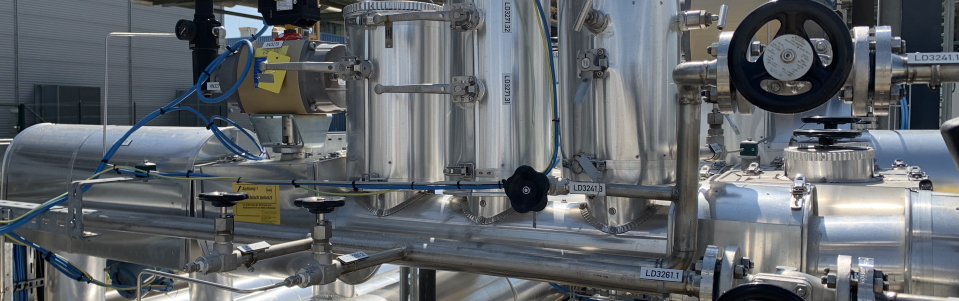
Fraunhofer IWES is helping the industry to establish a sustainable hydrogen economy.
The production of green hydrogen for the decarbonization and defossilization of industrial processes will make a decisive contribution to the achievement of the climate goals. In addition, intelligent integration can make a valuable contribution to energy storage and power grid stabilization. The reliable operation of electrolyzers and systems all along the H2 value chain is key to minimizing the risks of upscaling hydrogen production.
The upcoming ramp-up and the associated increase in demand for electrolysis capacity pose challenges not only for manufacturers but also for future operators. Production processes, measurement and monitoring procedures, and integration concepts cannot simply be scaled up from manufacturing to industrial dimensions.
Embedding hydrogen in the energy system and in industrial processes poses challenges in terms of deployment behavior and operating models. This is why Fraunhofer IWES operates three hydrogen labs for the testing and validation of hydrogen-relevant components along the value chain: from production via electrolysis to storage and use in PtX processes or fuel cells . In doing so, Fraunhofer IWES is helping the industry to establish a sustainable hydrogen economy. The hydrogen labs have different focuses:
The offer ranges from stack testing in the 45 kW range up to multi-megawatt testing capacity for operation under real conditions. Dynamic loads are simulated, as are environmental conditions and mechanical loads. Digital simulations accompany the process, describe procedures, and serve to optimize techno-economic key figures. Analyses are carried out across the board in order to develop methods and test procedures for electrolyzer materials and components and to apply them on a laboratory scale. Real-time monitoring of H2 and O2 purity, quality and safety control, trace analysis, and parallel process simulation for evaluating and optimizing parameters are also part of the portfolio.
Fraunhofer IWES can draw on many years of expertise in standardization issues in the wind industry. The partnerships with and expertise of pioneering institutions and companies enable Fraunhofer IWES to develop standardized test procedures for hydrogen technologies.

As part of the H2-SMORE “Megawatt-scale H2 stack test for offshore electrolysis” project, a megawatt-scale PEM electrolysis stack is being tested under realistic operating conditions at the Fraunhofer IWES Hydrogen Lab Leuna to determine its operational and aging behavior under offshore load conditions. BMFTR, 05/2026 – 04/2027
more info
Based on a comprehensive data analysis, the project partners are developing a “Roadmap 2035” with recommendations for closing gaps in the testing infrastructure for electrolyzers and PtX production, thereby enabling the achievement of the EU’s green hydrogen targets and the transition of the economy to renewables. European Commission, 04/2026 – 09/2027
more info
The project partners are developing new, practical, and flexible training and knowledge-transfer formats designed to enhance the transfer of knowledge regarding hydrogen technologies, train skilled workers, promote the regional hydrogen economy, and raise awareness of the energy transition. BMWE, 12/2025 – 11/2029
more info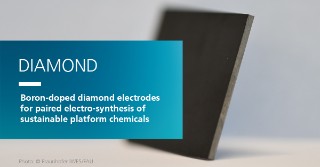
The project partners are developing durable electrodes and electrochemical processes for conversion of carbon dioxide to sustainable platform chemicals. BMFTR, 04/2024 - 03/2028
more info