 Fraunhofer Institute for Wind Energy Systems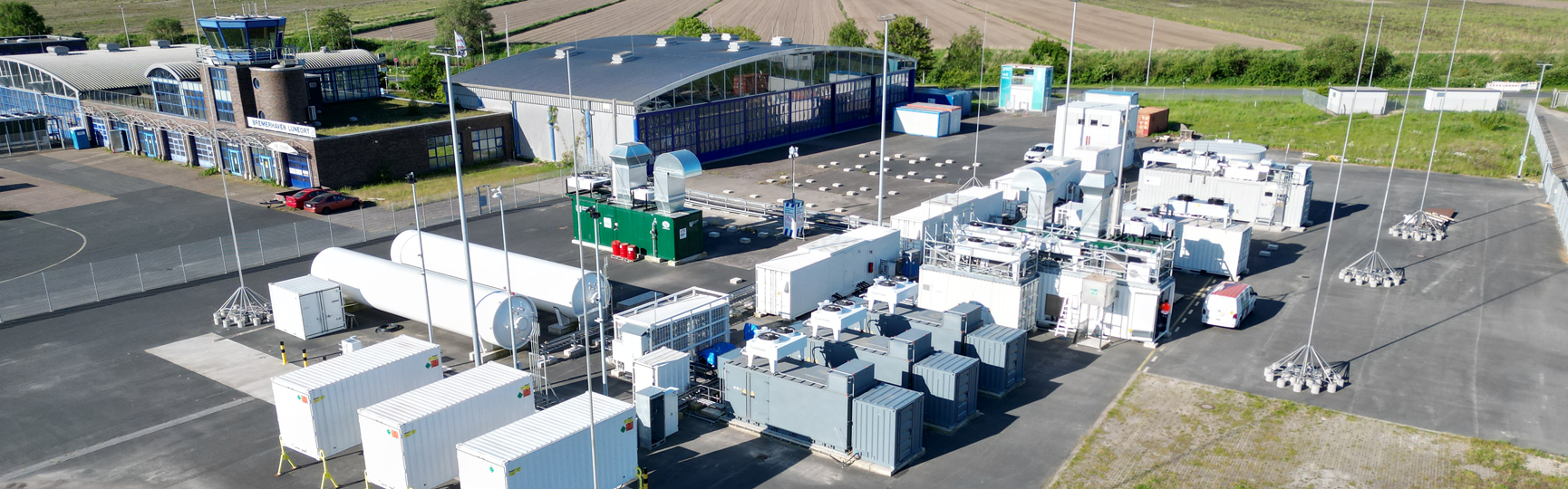
The IWES Hydrogen Labs in Bremerhaven, Leuna and Görlitz support the market ramp-up of green hydrogen for a CO₂-neutral industry.
Fraunhofer IWES operates the technology-independent hydrogen labs that serve as test platforms for the qualification and optimization of electrolyzers, ranging from the cell level to industrial stacks and full system integration. In addition to electrolyzers, hydrogen-consuming units and parts of the peripheral infrastructure are also tested here. Among other things, the long-term stability of materials and components in the dynamic operation of electrolyzers coupled with wind turbines is being tested.
Furthermore, the world’s leading facility for grid integration tests is available at the Dynamic Nacelle Testing Laboratory (DyNaLab). As future electrolyzers will be connected to the power grid as large consumers, their grid-supporting properties are very important, which is why their determination and optimization is a focus of research and development. We provide the manufacturers with support in the further development of their products accordingly.
There is also a test platform for coupled PtX processes available, allowing mapping of the entire value chain from renewable, load-flexible energy production to hydrogen production right up to material utilization as well as corresponding testing and researching on an industrial level.

Fraunhofer Hydrogen Labs
The market ramp-up of green hydrogen requires reliable, safe, and cost-optimized systems and components along the entire value creation chain for widespread use in industry and business. In addition to operational safety, costs play a central role here. The development of high-performance, cost-effective, and reliable components and the establishment of series production for electrolyzers and fuel cells generate savings potential.
Practice-oriented testing and modeling based on it significantly reduces the risk associated with the upscaling of electrolyzers to new performance classes and areas of application, which are essential for offshore applications among other things. Fraunhofer IWES boasts core competences in the field of electrochemical analysis and tests cells and stacks at microscopic level. Stack tests and system tests up to industrial scale can be performed in the hydrogen labs, making it possible to transfer knowledge acquired on a microscopic scale to large-scale systems. In the opposite direction, the feedback of effects observed in the whole system to the microscopic level, is also conceivable. This interplay of system and individual component tests allows holistic optimization.
The product “Green hydrogen”, its reactants, and the materials used to construct electrolyzers are subject to stringent requirements that must be verified and monitored. Fraunhofer IWES offers a wide range of analytical methods for this purpose. In addition to gas and liquid analysis, the materials or components used can be tested for corrosion resistance or surface changes prior to deployment. The liquid analysis conducted at Fraunhofer IWES also ensures consistent water and electrolyte quality and is used to investigate the durability and aging of the materials. Finally, gas analysis supports the monitoring of product quality directly at the plant.
Fraunhofer IWES considers the entire hydrogen value creation chain from production through to usage. The competencies and infrastructures of related institutes are called in for specific issues. Our customers include both globally operating groups and small and medium-sized enterprises in the region.
Furthermore, model processes of sector coupling can also be demonstrated and tested. This is particularly important in the case of fluctuating energy supply from renewable sources in order to ensure security of supply and to enable the storage of power surpluses. Operating strategies for stand-alone solutions will be developed across systems and optimized under techno-economic aspects.
A stable grid is a fundamental requirement for security of supply. The grids are not always designed for highly decentralized feed-in points with grid-side inverter connection and fluctuating energy supply.
When there is an oversupply of renewable energies in the grid at present, wind turbines are often switched off so as not to overload the grid – or the electricity is sold abroad at very favorable prices. One option is to utilize this “surplus electricity” to produce hydrogen, which serves as a chemical energy store. With increasing grid-connected electrolyzer capacity, these “consumers” will be also relevant from the perspective of grid stability. On the one hand, electrolyzers will have to comply with certain rules set by grid operators due to their dynamic operation, just as wind turbines, for example, have to do. On the other hand, the ability to provide grid system services potentially represents a very valuable contribution to system stability. Performing grid integration tests in the hydrogen labs will help to validate these system properties prior to large-scale market integration.
Key components of the hydrogen value chain will be modeled. A coherent data and model space will also be created for the co-simulation of usage scenarios for a future hydrogen economy.
We are working to expand a reference architecture for digital twins in such a way that it can represent the modularity of renewable energy systems and take registered changes to the system into account. This will create the basis for a comprehensive, generic digital twin of wind and hydrogen energy systems.
The Fraunhofer Application Center for Integration of Local Energy Systems ILES at Fraunhofer IWES investigates hydrogen-based multi-energy systems. The focus here is on modeling and control, taking into account the aging of electrolyzers. We use the system class of multilinear models and apply them in model-based supervisory controllers of multi-stack systems, for example, to control the power of the individual stacks.
