 Fraunhofer Institute for Wind Energy Systems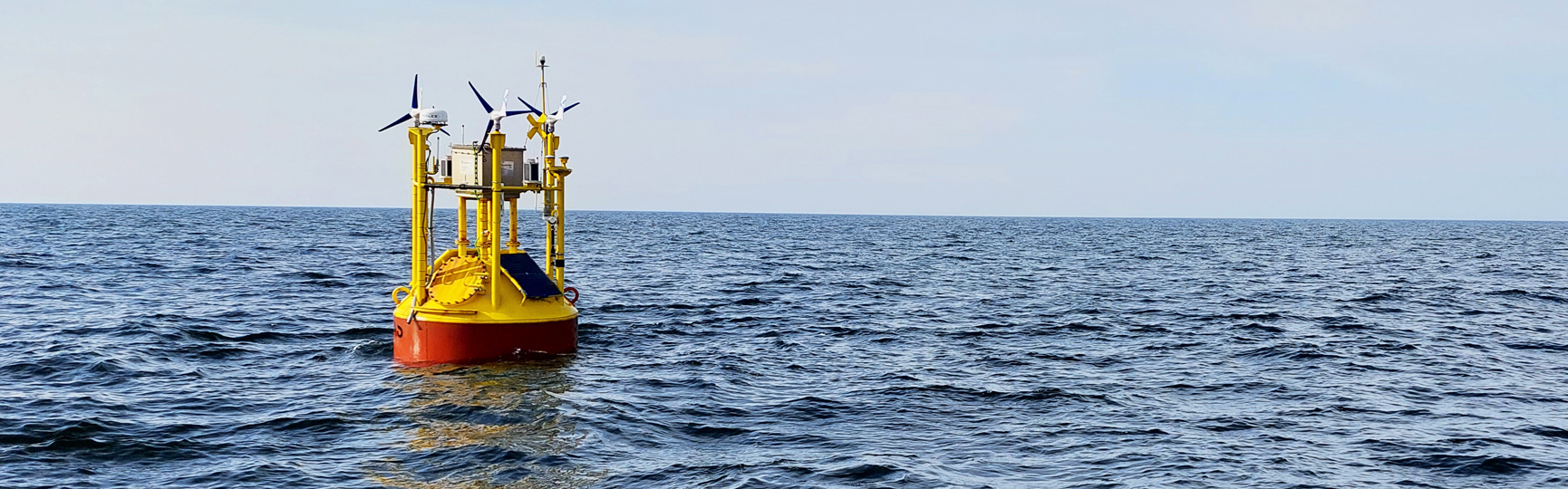
The lidar buoy provides quick, reliable, and cost-effective measurement data for offshore wind farm planning.
Wind turbines are exposed to complex conditions both onshore and offshore. The challenges for the numerical simulation and assessment of potential sites are correspondingly different, making precise modeling of wind fields indispensable. IWES is active in the optimization of numerical methods and data sets on all relevant scales in order to meet the industry’s requirements. For example, during the construction of offshore wind farms, the wind parameters influence the design and layout of the turbines as well as their components, including the foundations and towers. IWES conducts offshore lidar surveys in order to customize the numerical models for the sites. To this end, it has developed lidar measuring buoys, which record meteorological and oceanographic measurement data on the high seas. IWES employs innovative measurement concepts – using a variety of remote sensing technologies – to document the wind conditions.
When a turbine is at a standstill or fails, it can begin trundling. In turn, this can result in the wind reaching the rotor blades at very high angles of attack. This leads to vortex shedding, which triggers heavily alternating loads on the blades and can cause them to vibrate. Depending on the intensity of the vibrations, they can damage or even destroy the blade or the turbine. As there are no reliable models currently available for this process, IWES performs computational fluid dynamics (CFD) simulations on flexible rotor blades. This makes it possible to identify a rotor blade’s susceptibility to such vibrations in certain scenarios and implement countermeasures where appropriate.
Wind turbine rotor blades are currently designed to be slender and flexible. This has a range of advantages, including aerodynamic ones. One disadvantage is that the flexibility can result in the development of undesirable vibrations. In blade design, it is possible to determine and calculate the behavior of the rotor blades well for standard turbine operation. However, this is not the case if the flow behavior on the blades becomes highly unsteady, e.g., due to vortex shedding. This happens with high wind speeds or in cases where the turbine is not in operation or, in extreme cases, can no longer be controlled.
Computational fluid dynamics makes it possible to investigate precisely this problem with a physics-based approach to flow calculation. IWES has created the possibility of a flow structure-coupled simulation with the open source code OpenFoam. In this approach, non-linear beams are mapped for the structure on the basis of the geometrically exact beam theory (GEBT) in order to be able to visualize even large deformations with precision. This method makes it possible to analyze the blade vibrations in critical cases in detail and compare them with simplified model calculations.
In the scope of OpenFoam, Fraunhofer IWES developed a comprehensive simulation setup for wind turbines, which is being continuously validated as part of the IEA Wind Task 47 and with data from the HighRe project. This makes it possible to include trundling turbines and the dynamic yawing of the turbines in the simulation. Independently of the vortex issue, it is also possible to integrate aerodynamic elements into the simulation, which contribute to improving the aerodynamics.
CFD calculations take a considerable amount of time. IWES utilizes its many years of expertise in the field of high-performance computing on appropriate computers to carry out the calculations in an optimized and efficient manner. The institute advises and trains companies in order to open up the possibilities of open source CFD for industry.
Post-construction analysis (PCA) provides operators and owners of wind turbines with important information on their energy yield and performance. In cooperation with partners in public and bilateral projects, IWES has compiled a representative data set of offshore wind farm data for the development of PCA methods.
The combination of wind farm yield data analyses with numerical methods and models makes it possible to consider the causes for the performance of a wind farm individually. In addition, a data set from numerical weather simulations is employed to take into account relevant parameters such as the calibration of models for wake calculation.
In fact, integrating the IWES’ methods makes it possible to answer a far larger number of questions. For example: How much would the wind farm actually have been able to generate during grid supply outages as well as during feed-in restrictions (feed-in management)? Or: What effects do neighboring farms have on the expected yield and can previous data already confirm this? The application of the methods results in greater certainty about the yield to be expected in the future compared to previous yield assessments.
IWES is constantly working on optimizing the range of PCA consulting services it offers the wind industry and pushing ahead with the standardization of the methods in an ongoing research project.

Wind farm optimization with Flow © Fraunhofer IWES
Offshore wind farms are increasingly being constructed at sites mostly far away from the coast, where the wind conditions are not known with sufficient accuracy. Even at locations surveyed in the past, subsequently constructed wind farms with their wake effects can lead to a change in the prevalent wind resource. The different wind parameters are required not only for determination of the wind potential, and thus for calculating the profitability of a wind farm, but also for the design/layout of the wind turbine and its components, including the foundations and towers. Accurate measurement data, low measurement uncertainties, and, additionally, high availability are generally indispensable. To this end, Fraunhofer IWES has developed its own measurement buoy, which records meteorological and oceanographic measurement data relevant for the wind industry on the high seas. IWES also creates innovative measurement concepts utilizing a wide range of different remote sensing technologies.
Fraunhofer IWES has been working on the development of floating lidar systems (FLS) and methods for the correction of measurement data corrupted by the movements of the lidar buoy itself since 2009. The first prototype of the Fraunhofer IWES wind lidar buoy was tested for the first time offshore in 2013 and has also been in use in commercial measurement campaigns to determine offshore wind potential since 2017 and is certified for turbulence intensity measurements (OWA Stage 3+).
In addition to the data analysis, IWES also takes care of the planning of the measurement campaigns as well as the installation, operation, and maintenance of the lidar buoy.
The lidar buoys are made of a robust steel body for measurements far out at sea. The core element of the buoy – the WindCube V2.1 or ZX300 lidar device – is also additionally protected by an aluminum casing. The buoy’s superstructures allow the installation of further meteorological and oceanographic measuring sensor technologies; customized buoy structures are also possible.
IWES has performed numerous comparative measurements on measuring masts in the North Sea to guarantee the accuracy of the measurements and reduce measurement uncertainties, developing a wide variety of type classifications and methods for correcting turbulence intensity (TI) when doing so.
In addition to the development and application of the FLS technology, IWES also plays a leading role in the standardization of the FLS application – including OWA roadmaps and the PT 61400-50-4 standard – and also offers its expertise independently of its own lidar buoy.
Reliable and meaningful wind measurements are required in different phases of the life cycle of a wind project and in many areas of wind energy research. IWES predominantly employs wind lidar technology – be that as a vertical profiler on buoys (as described above) and vessels, foreseeably on wind turbine nacelles, or scanning lidars with flexible scan geometries and large ranges – to generate extensive measurement data. These data are used to plan wind farms, in operation, and to validate wind farm models or for the calibration of mesoscale simulations. For example, IWES is implementing innovative measurement concepts in the projects FLOW and NEMO .
Since 2025, Fraunhofer IWES has been operating an innovative wind radar system that enables three-dimensional wind field measurements at previously unattainable distances and resolutions. The so-called dual Doppler wind radar, consisting of two synchronously operating radar units, has the potential to take the understanding of wind currents in and around wind farms to a new level. In the Windpark RADAR project, research is currently underway to thoroughly validate the measurement method scientifically. The goal is to make this fundamentally new technology available to the wind industry.
The system measures wind conditions over an area of several hundred square kilometers up to several kilometers in height, recording several million wind measurements every two minutes. With such data, dual Doppler wind radar technology can reduce investment risks through improved site assessment and contribute to the optimization of wind farms, for example by simultaneously determining the power curves of all wind turbines in a wind farm. In the medium term, Fraunhofer IWES will offer corresponding measurement services for project planners and operators.
In addition, Fraunhofer IWES has taken on a leading role in recent years in the normative and pre-normative standardization of wind measurements using remote sensing. Among other things, IWES is an operating agent of IEA Wind Task 52 on wind lidars.


Measurement campaigns with Wind LiDAR buoys
Wind farm RADAR: Validation and Demonstration of Dual Doppler Radar Wind Field Measurements